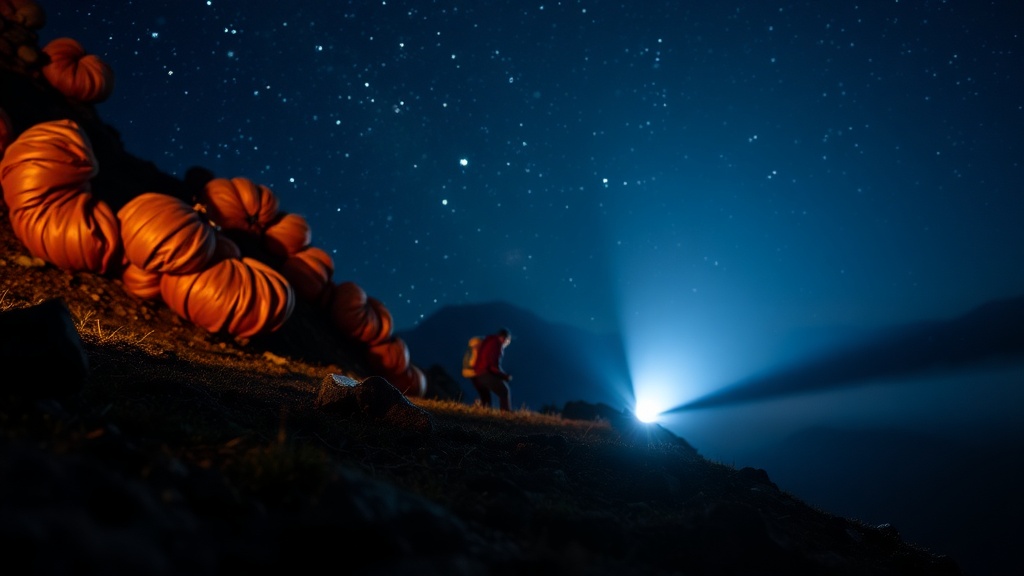
Why You Should Always Carry a Headlamp Instead of a Flashlight

Approximately 25% of all hiking-related search and rescue incidents in the Pacific Northwest are directly linked to darkness and inadequate illumination. This post explains why the headlamp is a non-negotiable piece of essential gear for Cascades hikers and why relying on a handheld flashlight is a logistical failure that can lead to injury or getting lost. You will learn the technical differences between beam types, how to calculate lumen requirements for different trail conditions, and how to manage battery life to ensure you aren't left in the dark during a descent.
The Fundamental Problem with Handheld Illumination
The primary reason a flashlight is an inferior tool for hiking is the loss of "hands-free" capability. In my previous career in logistics, efficiency was measured by how many tasks a single operator could perform simultaneously without compromising safety. On a technical trail like the Enchantments or a steep descent on Mount Si, your hands are your most important tools for stability. If you are using a handheld flashlight, you have effectively neutralized your ability to use trekking poles, scramble over rock faces, or stabilize yourself during a slip.
When you carry a flashlight, you are forced to choose between seeing the ground and maintaining balance. If you encounter a technical section—such as a root-filled descent in the North Cascades—you must hold the light in one hand and a pole or a rock in the other. This creates a single point of failure. If you slip, you drop the light, and you are now navigating a high-consequence environment in total darkness. A headlamp, such as the Black Diamond Storm 500-R, keeps the light source fixed to your line of sight, allowing your hands to remain dedicated to balance and navigation.
The Physics of Sight Lines
A headlamp moves with your head. This is a critical distinction. When you look down at your feet to navigate a step, the light follows your eyes. A flashlight requires you to tilt your wrist or arm to aim the beam. This constant adjustment causes "peripheral blindness," where you lose situational awareness of what is happening to the sides of your path. In a high-stress situation, such as an unexpected storm or a rapid temperature drop, the ability to maintain a consistent field of vision is vital for preventing trips and falls.
Understanding Lumens and Beam Patterns
Do not be fooled by marketing that focuses solely on high lumen counts. A high lumen rating is useless if the beam pattern is poorly suited for the terrain. You need to understand the difference between a "flood" beam and a "spot" beam to prepare for different stages of a hike.
- Flood Beam: This provides a wide, even distribution of light. It is essential for close-range tasks like reading a map, setting up shelter in the woods, or navigating a cluttered campsite.
- Spot Beam: This is a concentrated, narrow beam designed for distance. You need this when you are on a long approach or need to see a trail marker far ahead of you.
- Hybrid Beam: High-quality modern headlamps, like those in the Petzl Actik Core series, offer a hybrid approach, allowing you to toggle between a wide flood for immediate foot placement and a tight spot for long-distance visibility.
For most Cascades hikers, I recommend a headlamp that offers at least 300 lumens for general use, but check the "max lumens" rating. If a light peaks at 1000 lumens but drops to 20 lumens after an hour, it is not a reliable tool. You need a consistent, mid-range output that won't die halfway through a night hike.
The Importance of Color Temperature
The color of the light—measured in Kelvin (K)—matters more than most people realize. A "cool" blue-white light (5000K+) can be jarring and may actually decrease your ability to see depth in low-light conditions. A "warm" light (around 3000K-4000K) is often better for maintaining night vision and is more effective at cutting through light mist or fog, which is a frequent occurrence in the mountains.
Battery Management and Redundancy
In logistics, we plan for the "worst-case scenario" rather than the "expected scenario." If you are hiking in the backcountry, you cannot assume you will be back at your vehicle by sunset. You must plan for a "darkness contingency." This means your light source must be capable of lasting much longer than your planned trip duration.
There are two main power sources for headlamps: disposable alkaline/lithium batteries and rechargeable lithium-ion packs. Both have specific advantages and drawbacks:
- Disposable (AA/AAA): These are highly reliable in cold temperatures. If you are hiking in late autumn or winter, the chemical reaction in alkaline batteries slows down significantly. I always recommend carrying a spare set of lithium AAA batteries (like Energizer Ultimate Lithium) because they hold their charge better in the cold than standard alkaline.
- Rechargeable (Internal Li-ion): These are more environmentally friendly and offer higher lumen output per gram. However, if your battery dies in the middle of a trek, you cannot simply "swap" it. You are dependent on your power bank.
If you choose a rechargeable model, you must also carry a high-capacity power bank and a reliable cable. If you are using a headlamp to navigate while also using your phone for basic navigation without a GPS, you must ensure your power management strategy accounts for both devices. A dead headlamp is a life-threatening situation; a dead phone is a logistical inconvenience.
The "One-Plus-One" Rule
Never rely on a single light source. The most basic rule of backcountry safety is to carry one primary light and one backup. Your primary should be a high-quality headlamp. Your backup should be a smaller, lightweight, but reliable light source—perhaps a small, lightweight flashlight or a secondary, lower-output headlamp. If your primary headlamp fails due to a mechanical error or a broken headband, you are not left completely blind.
Common Mistakes to Avoid
I see these mistakes frequently among hikers who think they are "prepared" because they have a light in their pack. Avoid these specific errors:
1. Not Testing the Light Before the Hike: Never assume a light works just because you put it in your pack. Test the light in your house, then test it again in the field. Check the brightness levels at various settings to ensure you know how much power each setting consumes.
2. Ignoring the Weight-to-Brightness Ratio: Some hikers carry massive, heavy-duty lanterns for camping, thinking they'll need them for hiking. A lantern is a stationary tool. A headlamp is a mobile tool. Do not confuse the two. A heavy lantern will slow you down and won't help you navigate a technical descent.
3. Neglecting the Headband Fit: A headlamp that bounces while you walk is a distraction and can lead to eye fatigue. Ensure your headlamp has an adjustable, durable headband. If you are running or moving quickly through technical terrain, a loose headlamp can easily fly off your head, leaving you in the dark.
4. Forgetting to Pack a First Aid Kit: If you trip in the dark because your light failed, you will likely need more than just a light to fix the situation. Always ensure your illumination gear is packed alongside a small first aid kit. A light helps you see the hazard; the kit helps you manage the result of the hazard.
Final Checklist for Your Next Trip
Before you head out on your next trek in the Cascades, run through this checklist to ensure your lighting kit is up to professional standards:
- Primary: High-quality headlamp (minimum 300 lumens) with a wide flood/spot capability.
- Secondary: A lightweight backup light source.
- Power: Extra batteries (Lithium preferred for cold) or a fully charged power bank with a compatible cable.
- Verification: Have you tested the light and the battery levels within the last 24 hours?
- Functionality: Does the headlamp have a "red light" mode? (Red light is excellent for preserving your night vision and for signaling without blinding others).
Precision in gear selection is the difference between a successful summit and a search-and-rescue operation. Treat your headlamp as a critical navigation tool, not an afterthought. If you wouldn't leave your car without headlights, do not leave the trailhead without a reliable, hands-free light source.