Clear Creek, Dirty Water: My Cascades Treatment Protocol When I Don’t Trust the Source
Clear Creek, Dirty Water: My Cascades Treatment Protocol When I Don’t Trust the Source
If your water plan is "it looks clean," your risk model is broken.
In the Cascades, I see hikers fill bottles from clear, cold streams and call that "natural filtration." That is not filtration. That is gambling with parasites, bacteria, and bad timing.
This is the field protocol I use when I need reliable water without turning the day into a science project.
First Principle: Clear Water Can Still Make You Sick
CDC is explicit: even clear mountain water can contain germs from human or animal waste, and boiling is the best treatment method when possible. If I cannot boil, the next best sequence is filter first, then disinfect.
That order matters. Most field mistakes happen because people do one method halfway and assume they covered everything.
The Four Failure Modes I See Constantly
No pre-filtering in cloudy water
Fine sediment reduces chemical and UV effectiveness. If water is cloudy, I settle and pre-filter first.
Wrong filter assumptions
Not every filter handles everything. CDC notes that many portable filters remove parasites but not viruses, and some do not remove all bacteria unless pore size is sufficiently small.
Chemical treatment used like a magic button
Chlorine and iodine are useful, but they do not reliably solve all parasite problems. Chlorine dioxide has better parasite performance than basic chlorine/iodine, but contact time and temperature still matter.
Treating toxin risk like germ risk
If you are near a harmful algal bloom, boiling will not make cyanotoxins safe; CDC warns boiling can concentrate toxins. If bloom conditions are present, the right move is source replacement, not treatment optimism.
My On-Trail Water Decision Ladder
I run this in order, every time:
Pick the best source, not the closest source
I prioritize flowing water above trail corridors, livestock impact, and stagnant margins.
Reject bad sources immediately
Scum, paint-like sheen, foul odor, dead fish, or visible bloom means no collection. Move on.
Pre-filter when needed
If water is silty, I use a bandana or dedicated pre-filter and let particulates settle before treatment.
Primary treatment choice
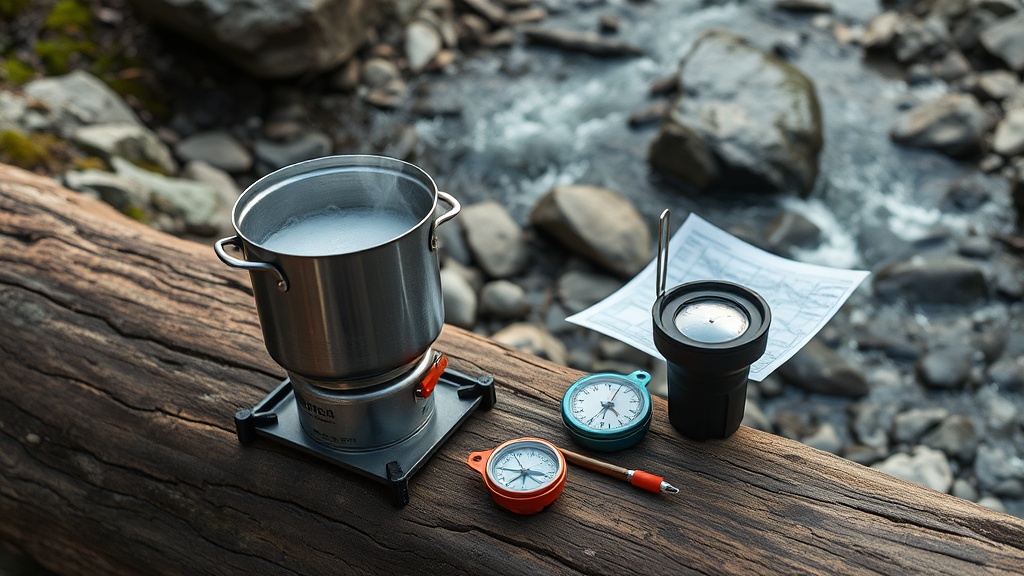
- Boil when I can: rolling boil for 1 minute; above 6,500 ft, 3 minutes.
- Filter + disinfect when boiling is impractical.
Redundancy for high-consequence days
For shoulder season, remote routes, or family/dog days, I stack methods: filter, then disinfect or boil at camp.
Protect the clean side
Dirty bottle and clean bottle stay separated. Mouthpieces and threads get treated as contamination points.
Fast Gear Matrix (What Each Method Is Good For)
| Method | Strength | Weak point | When I choose it |
|---|---|---|---|
| Boiling | Broad kill spectrum for germs | Fuel/time cost | Camp stops, cold days, uncertain contamination |
| Squeeze filter | Fast and efficient in flowing sources | Can miss viruses; can clog in silt | Most day hikes with good source quality |
| Chemical disinfectant | Lightweight backup and virus coverage | Performance depends on chemistry/time/temp; weaker on some parasites | Secondary layer after filtering |
| UV treatment | Fast in clear water | Poor in cloudy water; battery dependency | Summer clear-water trips with full charge backup |
Hard Opinions (Because This Is Where People Get Hurt)
- "I only drank a little" is not a protocol.
- One ultralight tablet in murky runoff is not a protocol.
- Sharing one untreated bottle with your dog and your kid is not a protocol.
If your plan has no redundancy and no source-selection discipline, your plan is luck with better branding.
Family and Dog Logistics
I treat dog/family days as higher consequence, not casual days.
- Carry extra treated water so your dog is not forced to drink from suspect puddles near trailhead lots.
- Keep a separate collapsible bowl and do not backwash bowl water into your clean bottle zone.
- On high-traffic trails, assume upstream contamination and treat everything.
Bottom Line
Water treatment is not about buying the "best" gadget. It is about sequence discipline:
- Source quality
- Pre-filtering when needed
- Correct treatment method
- Clean-side contamination control
Run that sequence every trip and you will avoid most preventable waterborne mistakes I keep seeing in the Cascades.
Sources
- CDC, About Water Treatment Options When Hiking, Camping, or Traveling (updated January 30, 2025): https://www.cdc.gov/drinking-water/prevention/water-treatment-hiking-camping-traveling.html
- CDC, Preventing Illnesses Caused by Harmful Algal Blooms: https://www.cdc.gov/harmful-algal-blooms/prevention/index.html
- Washington State Toxic Algae monitoring portal (Dept. of Ecology): https://www.nwtoxicalgae.org/